
Explainer · September 3, 2026 · 6 min · By Zahra Pemberton
What Does an Ingrown Hair Look Like? A Stage by Stage Visual Guide for Curly and Coily Hair
Almost every reference photo of an ingrown hair shows a red halo on pale skin. On deeper skin tones that red halo is the one sign you should not rely on, and the bump you can feel usually arrives days before anything you can see.
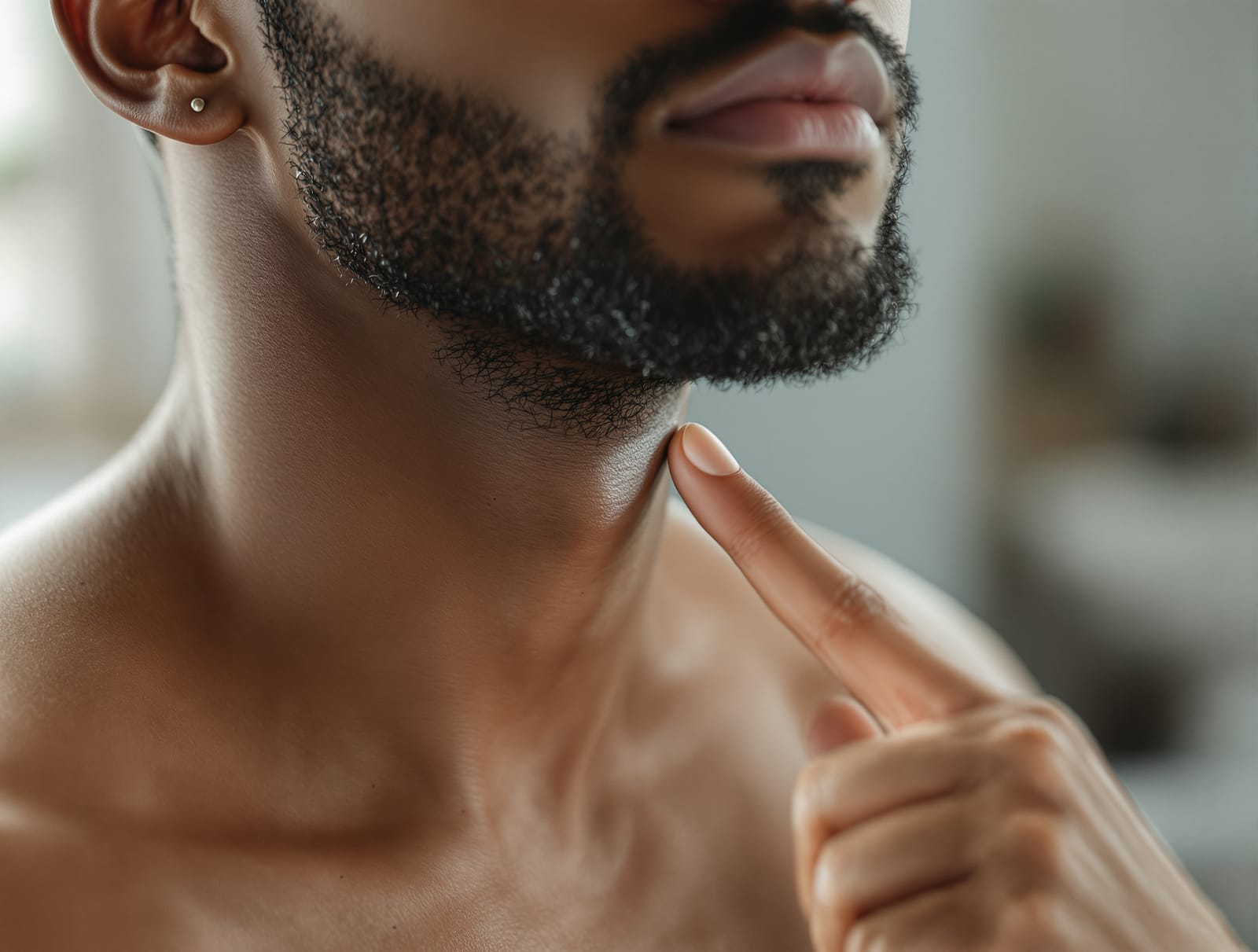
Ask a search engine what an ingrown hair looks like and you get the same picture over and over: a single angry red dot on light skin with a dark hair curled inside it. That picture is accurate for a minority of the people who search for it. On curly and coily hair growing out of brown or dark skin, the redness is muted or invisible, the bumps come in clusters rather than one at a time, and the earliest stage looks like nothing at all. This guide walks through what an ingrown hair looks like on textured skin at four points in time, day one, day three, day seven and week three, and gives you a three question mirror read to sort what you are seeing. That timeline and mirror read are the original part of this page; no clinical source lays out the stages this way for skin of color, and it is the reason the page exists.
What does an ingrown hair look like on day one, when there is nothing to see yet. The first stage is felt, not seen. Run a clean fingertip over the area that was shaved, waxed or plucked two or three days ago. What you are hunting for is a firm pinhead of resistance under the surface, usually along the line of hair growth, with skin over it that still matches the surrounding tone. On Mayo Clinic's list of symptoms, this is the small solid bump stage, and it comes before pain, before pus and before any color change. If you shave the neck or bikini line, this fingertip pass is worth doing every time, because day one is the only stage where leaving the hair alone reliably lets it grow out on its own.
Day three is when the bump becomes visible, and the color is the part most guides get wrong. By the third day the papule is raised enough to catch the light. On lighter skin it is pink to red. On brown and dark skin the marker is different. Look for a dome shaped bump slightly shinier than the skin around it, sometimes with a faint darker or purplish halo rather than a red one, and often several bumps in a loose row where the razor passed. The NHS describes the classic look as raised, itchy spots that can fill with pus, and notes that on brown and black skin the spots may look darker rather than red. In practice, a cluster of matched dome shaped bumps with a dark halo, tender when pressed, is the most reliable day three picture on textured skin.
Day seven is the stage that gets photographed, and the one where the hair itself shows up. Around a week in, one of two things has happened. Either a tiny loop of hair has surfaced through the skin next to the bump, or the bump has turned into a yellow headed pustule with no hair visible. Those two appearances point to two different mechanics, which our pillar guide on why curly hair ingrows so much more explains in full. A visible loop means the hair left the follicle, grew outward, then curved back and pierced the skin from above. A firm bump with no loop means the sharp cut tip never left the follicle and drove sideways into the wall. Both are ingrown hairs. Only the first one can be safely lifted with a sterile point, which is why our guide on freeing a trapped ingrown hair starts by asking whether you can see the loop.
Week three is when an ingrown hair stops looking like an ingrown hair. The bump has usually flattened. What remains on textured skin is a flat brown spot, sometimes slightly darker at the center, that can persist for months. This is post inflammatory hyperpigmentation, not an active lesion, and picking at it will only deepen it. If instead the bump has grown larger, firmer and skin colored rather than flattening, it may be turning into a cyst or a keloidal papule, and that is the moment to read our guide on when an ingrown hair becomes a cyst. DermNet's review of pseudofolliculitis barbae describes exactly this progression from papule to pustule to dark mark to occasional keloidal scar, and it is most pronounced on curly, coily hair.
The three question mirror read. Stand in daylight, not bathroom light, which flattens the surface and hides the dome shape. Question one: is the bump in a line or a cluster along a shaved, waxed or plucked area? If yes, an ingrown hair is the leading candidate. A single bump far from any hair removal, or bumps spread evenly across an area that was never shaved, points elsewhere. Question two: can you see a hair, either a loop breaking the surface or a dark dot at the center of the bump? A visible hair confirms it. No visible hair does not rule it out, because the transfollicular type never surfaces. Question three: is the center a white or yellow head with a hair emerging through the middle of it? That pattern, pus centered on a hair, is more typical of bacterial folliculitis, which MedlinePlus describes as infection of the follicle itself, and it needs a different response than an ingrown hair. Our comparison of folliculitis versus ingrown hair on textured skin goes through that distinction in detail.
What the reference photos leave out. Almost every published image set was shot on light skin, where redness is the dominant cue. A 2023 review of treatments for pseudofolliculitis barbae in Clinical and Experimental Dermatology (PubMed 36840647) notes the condition disproportionately affects people of African descent, yet the photographs most people learn from do not show what it looks like on that skin. The practical consequence is that people with brown or dark skin wait for a red halo that never comes, and by the time they act, the bump is already at the pustule or dark mark stage. If you have textured hair and skin of color, retrain your eye: look for the dome, the shine, the cluster and the dark halo, and trust your fingertip on day one over your eyes on day three.
What to do with what you see. At day one, stop shaving that area and let the hair lengthen. At day three, a warm compress and a gentle exfoliating acid can soften the surface enough for the hair to exit on its own. At day seven with a visible loop, lift it as described in the freeing guide and do not pluck it. At day seven with a pustule and no loop, leave it and see a clinician if it spreads or grows. At week three with a flat dark mark, switch your attention from the hair to the pigment, which our guide on managing dark marks from razor bumps covers. Knowing which of the four pictures you are looking at is most of the decision.